Discovering the Timeless Tapestry of Japanese Noh Theatre: A Cultural Odyssey
The Ancient Art of Noh: An Introduction
When one steps into the dimly lit auditorium of a Noh theatre in Japan, they're not merely an audience to a performance—they are travelers, embarking on a journey through time and spirit. Noh theatre, a classical Japanese performing art that dates back to the 14th century, transcends mere entertainment. It evokes a deep cultural connection by seamlessly weaving together drama, music, and dance. Its unique presentation and timeless themes invite spectators to explore the spiritual landscape and societal values of historic Japan, making it an invaluable key to understanding the nation's cultural tapestry.
Roots and Evolution of Noh Theatre
To truly appreciate Noh, one must examine its origins and evolution. Noh theatre emerged during the Muromachi period, flowering under the patronage of shogunate rulers who viewed it as a symbol of sophisticated taste and power. The progenitors of Noh, Kan'ami and his son Zeami, were instrumental in refining its aesthetic and codifying its principles. Influenced by traditional Japanese beliefs and the Chinese performing arts, Noh theatre synthesized elements of Buddhist narrative, Shinto symbolism, and Nogaku (the precursor to Noh).
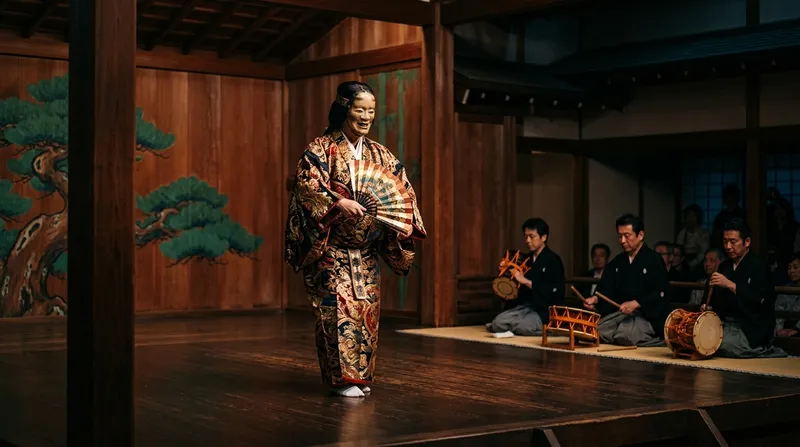
Distinct from other theatrical forms, Noh relies heavily on the power of subtlety and suggestion. It is, by design, minimalistic—employing a sparse set, symbolic props, and a limited cast. The performers' slow, deliberate movements and the haunting chant-like recitations create an atmosphere of profound contemplation, transporting audiences beyond the physical world and into realms of metaphysical elegance.
The Quintessence of Performance: Masks, Costumes, and Sound
Noh theatre captivates its audience through a unique confluence of visual and auditory elements, each serving a profound purpose. Masks, known as 'Nohmen,' are crucial to embodying characters ranging from gods and demons to spirits and human figures. These intricately carved masks convey subtle emotions with their static expressions, demanding that actors master the skill of nuanced body language to evoke life in their roles.
Costumes in Noh are a spectacle of their own, often lavishly embroidered and vibrantly colored. They symbolize the social status and personality of characters while ensuring the visual allure aligns with the poetic motion of each scene. The accompanying music—provided by a select few instrumentalists playing the flute (‘nohkan’) and percussion instruments such as the shoulder drum (‘kotsuzumi’) and stick drum (‘taiko’)—underscores the drama. This rhythmic and sometimes ominous score shapes the narrative pace, enhancing the mystical dimensions of the performance.
Themes and Stories: A Reflection of Japanese Beliefs
Noh plays predominantly draw on historical texts, myths, and literature, often revolving around themes of redemption, the transient nature of life, and the reconciliation of emotions. The narratives frequently explore the ethereal interactions between humans and the supernatural, encapsulating quintessential Japanese spiritual beliefs that intermingle life, death, and the afterlife seamlessly.
A sublime example is "Atsumori," a story about warrior spirit redemption that touches on the Buddhist concept of forgiveness. Characters in Noh often grapple with inner turmoil and existential musings, invoking a sense of mono no aware—a deep appreciation of the impermanence of life and beauty, which lies at the heart of Japanese aesthetics.
Experiencing Noh: Beyond Sight and Sound
Participation in a Noh performance is an immersive experience that requires more than passive observation; it calls for an open heart and a willing imagination. As a cultural experience, it challenges modern audiences, encouraging a meditative absorption into its solemn rhythms and an appreciation for its evocative symbolism.
For those keen to witness this unique cultural art form, venues across Japan, such as the National Noh Theatre in Tokyo and the Kanze Noh Theatre in Kyoto, offer regular performances. Viewing a Noh play gives one not just a glimpse into the traditions of old Japan but also a profound connection to the cultural pulse that continues to influence modern Japanese identity.
Conclusion: Noh in Contemporary Culture
Noh's endurance and relevance today lie in its ability to bridge the gap between ancient and modern, infusing contemporary art with a spiritual depth and philosophical richness. Its influence permeates various creative domains—visible in modern theatre, film, literature, and even popular media, where the themes of human fragility and spiritual introspection continue to resonate.
Through Noh theatre, visitors to Japan do not just witness an art form but partake in a centuries-long dialogue between the tangible and the ethereal. It serves as a poignant reminder of how deeply culture and performance art are intertwined, providing a timeless journey into the soul of Japanese tradition. Whether you are a seasoned theatre-goer or a curious traveler, experiencing Noh is akin to finding oneself in a different world, where time flows differently, and every gesture is heavy with meaning, inviting you to linger a little longer in its haunting, beautiful world.